OpenQASM 3 et le SDK Qiskit
Versions des packages
Le code de cette page a été développé avec les prérequis suivants. Nous recommandons d'utiliser ces versions ou des versions plus récentes.
qiskit[all]~=2.5.2
# Added by doQumentation — installs the packages this notebook needs if they are missing
import importlib.util

_needed = {"qiskit": "qiskit"}
_missing = [pip for module, pip in _needed.items()
            if importlib.util.find_spec(module) is None]
# One at a time, so a package that fails to install does not block the others
for _pip in _missing:
    %pip install -q {_pip}
if not _missing:
    print("\u2713 All required packages are installed")
Le SDK Qiskit fournit des outils pour convertir entre les représentations OpenQASM des programmes quantiques et la classe QuantumCircuit. Note : ces outils sont encore dans une phase exploratoire de développement et continueront d'évoluer à mesure que la prise en charge par Qiskit des capacités de circuits dynamiques exprimées par OpenQASM 3 s'améliore.
Cette fonction est encore dans la phase exploratoire. Par conséquent, il est probable que la syntaxe et les capacités évoluent.
Importer un programme OpenQASM 3 dans Qiskit
Tu dois installer le package qiskit_qasm3_import pour utiliser cette fonction. Installe-le avec la commande suivante.
pip install qiskit-qasm3-import
Actuellement, deux fonctions de haut niveau sont disponibles pour importer depuis OpenQASM 3 vers Qiskit. Ces fonctions sont load(), qui prend un nom de fichier, et loads(), qui prend le programme lui-même sous forme de chaîne de caractères :
import qiskit.qasm3
qiskit.qasm3.load(file_name)
qiskit.qasm3.loads(program_string)
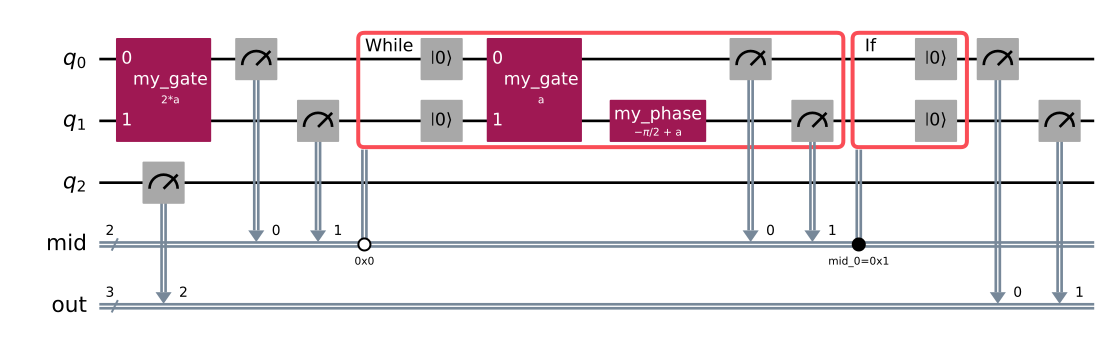
Dans cet exemple, on définit un programme quantique en OpenQASM 3 et on utilise loads() pour le convertir directement en QuantumCircuit :
import qiskit.qasm3

program = """
    OPENQASM 3.0;
    include "stdgates.inc";

    input float[64] a;
    qubit[3] q;
    bit[2] mid;
    bit[3] out;

    let aliased = q[0:1];

    gate my_gate(a) c, t {
      gphase(a / 2);
      ry(a) c;
      cx c, t;
    }
    gate my_phase(a) c {
      ctrl @ inv @ gphase(a) c;
    }

    my_gate(a * 2) aliased[0], q[{1, 2}][0];
    measure q[0] -> mid[0];
    measure q[1] -> mid[1];

    while (mid == "00") {
      reset q[0];
      reset q[1];
      my_gate(a) q[0], q[1];
      my_phase(a - pi/2) q[1];
      mid[0] = measure q[0];
      mid[1] = measure q[1];
    }

    if (mid[0]) {
      let inner_alias = q[{0, 1}];
      reset inner_alias;
    }

    out = measure q;
"""
circuit = qiskit.qasm3.loads(program)
circuit.draw("mpl")
Exporter vers OpenQASM 3
Tu peux exporter du code Qiskit vers OpenQASM 3 avec dumps(), qui exporte vers une chaîne de caractères, ou dump(), qui exporte vers un fichier.
Exemple avec dumps()
from qiskit import QuantumCircuit
from qiskit.qasm3 import dumps

qc = QuantumCircuit(2)
qc.h(0)
qc.cx(0, 1)
qc.measure_all()

dumps(qc)
'OPENQASM 3.0;\ninclude "stdgates.inc";\nbit[2] meas;\nqubit[2] q;\nh q[0];\ncx q[0], q[1];\nbarrier q[0], q[1];\nmeas[0] = measure q[0];\nmeas[1] = measure q[1];\n'
Exemple avec dump()
from qiskit import QuantumCircuit
from qiskit.qasm3 import dump

qc = QuantumCircuit(2)
qc.h(0)
qc.cx(0, 1)
qc.measure_all()

f = open("my_file.txt", "w")
dump(qc, f)
f.close()
Pour plus d'informations, consulte la section Exporter vers OpenQASM 3 de la référence API.
Étapes suivantes
- Découvre comment générer du code OpenQASM dans le guide IBM Quantum Composer.
- Passe en revue la référence API Qiskit OpenQASM 3.
- Consulte la rubrique Vérifier ton programme.
- Consulte la spécification évolutive d'OpenQASM (Live Specification).